







The history of steel begins with a journey that dates back to the earliest periods when humanity first felt the need for production. The discovery of iron is estimated to have occurred around 1000 BC, although it was discovered at different times in various parts of the world. The Sumerians and Egyptians, who lived approximately 4000 years BC, are known as the first societies to use iron in history. According to available information, iron production began in Anatolia and presumably in the northern regions of the Caucasus.
The history of steel emerged in the later stages of this journey, at a time when stronger and more durable materials were required.
According to collected information, the first iron material used was obtained from meteorites that fell to the earth. In areas with sufficient iron ore deposits, iron could be processed by melting it with charcoal and working it with an excess amount of wood. Through such processing methods, various techniques for obtaining iron were developed. Due to the technical and economic importance of metal, every experience gained regarding the properties of iron and steel was kept as a secret. As a result, production techniques remained confined to specific regions and spread to other areas only after long periods.
Iron and steel properties were utilized by humans in the form of hunting tools, spearheads, knives, and ornamental items. In the 10th century AD, the introduction of watermills created a revolution in iron production. The power generated by water increased the importance of proximity to ore deposits. Consequently, furnaces used to melt iron were moved closer to water sources, typically into valleys.
Since bellows operated by watermills could generate air pressure, much larger furnaces became possible. With sufficient heat, forgeable and scrap iron weighing up to 100 kilograms could be produced, and by the 12th century AD, temperatures high enough to smelt iron ore were achieved. This development led to the use of blast furnaces.
The highly fluid product obtained was initially undesirable and was therefore called “pig” iron, from which the term pig iron originates. The commercial production of pig iron in blast furnaces dates back to the 14th century.
HOW ARE IRON AND STEEL PRODUCED?
Although the question “How is steel produced?” was once a valuable form of knowledge known only to masters, today steel is produced under modern industrial conditions. Non-oxidized ores are roasted to form oxides, which are then melted to produce iron.
The reduction process involves removing oxygen from an oxide to obtain the metal. This reduction is carried out in blast furnaces using coke. A medium-sized blast furnace can process approximately 2000 tons of iron ore per day.
The development of iron production throughout the ages can be traced through different furnace systems used to smelt ore. The historical sequence of furnaces is as follows: blacksmith hearths, bloomery furnaces, fluid-bed furnaces, charcoal blast furnaces, coke-fired blast furnaces, direct reduction plants, and melting facilities.
In earlier times, the answer to “How is steel produced?” involved a much more complex production chain. Blacksmith hearths were furnaces made of hearthstone, clay, or rock fragments. In these furnaces, iron ore was forged with charcoal to transform it into iron. During this process, the gangue (worthless stone or mineral mixed with valuable ore) melted into slag, while iron remained in solid form. Initially, furnaces operated using natural air circulation; later, manually or foot-operated bellows were introduced.
The locations where liquid metal was produced were initially called “fluid-bed furnaces.” As furnace sizes increased, the term “blast furnace” came into use. In the early 18th century, charcoal was used as fuel in these furnaces.
IRON AND STEEL FACTORIES
In Türkiye, the first initiatives to establish iron and steel factories began during the Republican era. The first iron and steel factory was established in Kırıkkale.
The law concerning the establishment of the heavy iron industry in Türkiye was adopted on March 17, 1926, and entered into force after being published in the Official Gazette on March 29, 1926. Following research and studies, Karabük, located near coal mining basins, was selected as the site for the iron and steel industry. The facility, whose foundation was laid on April 3, 1937, continues production today under the name Kardemir Iron and Steel Factory.
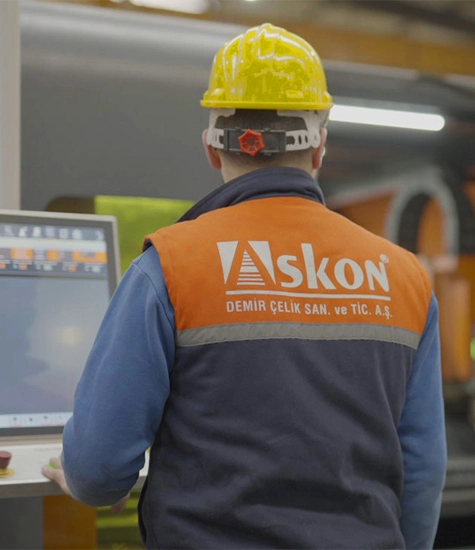
The ASKON Iron and Steel factory, founded in 1932 by Hilmi Konyalıoğlu, continues to contribute to Türkiye’s production capacity with its 85 years of experience, securing its place among the country’s leading iron and steel factories.
Research to date indicates that Türkiye has limited exploitable iron ore reserves. The country’s exploitable iron reserve is estimated at 115 million tons. High-grade iron ore reserves suitable for use in integrated iron and steel plants are found in Sivas, Malatya, Erzincan, Bingöl, Adana, and Kayseri regions.
Türkiye has an annual iron ore production capacity of 7.1 million tons, approximately 6 million tons of which are consumed by domestic iron and steel factories. Based on current estimates, if no new iron deposits are discovered, existing reserves would be depleted within 16 years at the current production rate, or within 7 years if all domestic demand were met solely from local sources.
For a country’s development, it is critically important that the iron and steel sector meets its raw material needs from domestic resources. In Türkiye, there are four areas with low iron content suitable for investment:
Malatya – Hasançelebi Field:
Contains 1.054 billion tons of reserves with 19.5% magnetite content. Mining rights belong to Erdemir Iron and Steel Factory.
Malatya – Hekimhan – Deveci Field:
Contains 40 million tons of siderite reserves with 39% iron and 4% manganese content. Mining rights belong to Kolin – Hekimhan A.Ş.
Erzincan – Kemaliye – Bizimşen Field:
Contains 23 million tons of magnetite and hematite reserves with 35–53% iron content. Mining rights belong to Bilfer A.Ş.
Bingöl – Genç – Avnik Field:
Contains 55 million tons of magnetite reserves with 54.6% iron content. Of this reserve, 6 million tons belong to Erdemir Mining, 16 million tons to Ceylan Construction, and 33 million tons to Dimin Mining.
When evaluating the history of steel from a broad and comprehensive perspective, it becomes clear that the techniques developed throughout the process and the constant desire to achieve better results have been the key factors driving human success.
Masters who relentlessly researched “How is steel produced?” and steel properties laid the foundations of today’s processing and production methods with the help of modern machinery. Iron and steel factories, through modern processing techniques and newly designed equipment, continue to play a vital role in advancing this process and passing it on to future generations.