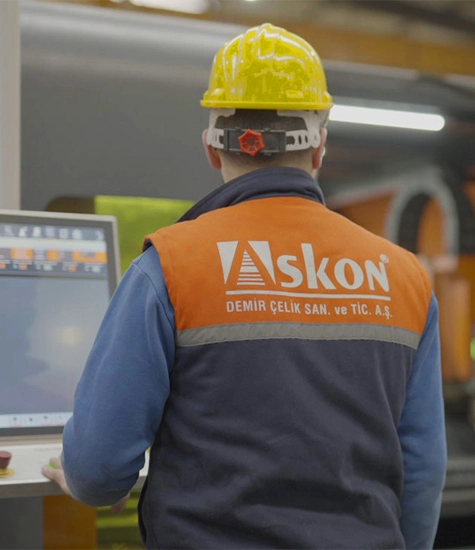








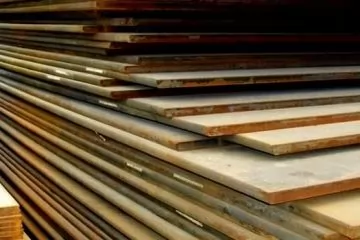
Thyssenkrupp Steel Europe Heavy Plate Unit products—XAR wear plates and N-A-XTRA / XABO and PERFORM high-strength steels—are delivered across Türkiye as quickly as possible, at the requested place and time, with full authorization on behalf of the Thyssenkrupp factory by ASKON DEMİR ÇELİK A.Ş.
With a customized solution approach, our steels are processed according to all types of technical drawings using laser, oxy-fuel, plasma, machining, welding, drilling, and bending, providing our customers with the most suitable service. Our products are factory-branded as “Made in Germany by Thyssenkrupp Steel Europe.”
The surface quality, straightness, and edge accuracy of our plates meet the indispensable requirements of every customer. In addition, both factory officials and our in-house sales representatives provide fast and efficient service to our customers.
Thyssenkrupp Steel Europe Heavy Plate Unit products—XAR wear plates, N-A-XTRA / XABO, and PERFORM high-strength steels—are industrial steels that cannot be produced in Türkiye and must be imported.
The sectors we serve include heavy machinery industry, construction equipment manufacturing, cement and asphalt plants, stone and sand quarries, mines, thermal power plants, dam constructions, truck-mounted cranes, waste and scrap trucks, and many others. Below is a brief overview of our products available in various grades for different purposes.
What Are N-A-XTRA / XABO Steels and Their Properties?
N-A-XTRA and XABO steels were first produced in Europe 40 years ago. Today, they are manufactured in thicknesses ranging from 3 to 100 mm, with yield strengths of up to 1100 MPa. Their most successful application areas are commercial vehicles and mobile cranes; they are also used in mining equipment, pressure vessels, and pipelines.
When used in heavily loaded structures, N-A-XTRA and XABO steels offer significant advantages by allowing thickness reduction and the construction of lighter structures. When N-A-XTRA is used instead of St52, thickness savings of up to 50% can be achieved, while with XABO, savings can reach 70%. Another advantage of high-strength steels is the reduction in welding consumables and lower welding costs.
Considering legal regulations and restrictions on vehicle dimensions, axle loads, and total weights in commercial vehicle and mobile crane production, vehicle lightness has become increasingly important. Thanks to high-strength steels, cranes capable of lifting up to 1200 tons have been produced.
N-A-XTRA and XABO steels are delivered shot-blasted and primed for surface quality. A low-zinc silicate primer is generally applied with a thickness of 12–18 microns. Primed plates can be cut smoothly using laser cutting. The inorganic content is suitable for welding, and paint removal is not required.
What Are the Technical Properties of N-A-XTRA Steel?
N-A-XTRA 700 is among the most widely used quenched and tempered steels due to its ease of processing. It has a minimum yield strength of 700 MPa and offers excellent toughness down to -60°C.
Thanks to its superior toughness, it allows welding with higher heat input and longer cooling times (t8/5). Its chemical composition makes it suitable for cold forming and all common welding methods. A low carbon content is one of the characteristic features of N-A-XTRA.
When N-A-XTRA is used instead of St52, preheating costs are reduced. It can be welded without preheating up to 20 mm, depending on the welding method. Both manual and automatic welding are possible. Depending on hydrogen content and heat input, welding may be carried out with preheating.
The service temperature should not exceed 250°C. To prevent deterioration of steel properties due to thermal cycles during welding, an upper limit must be set for interpass temperature. Post-weld heat treatment is generally not required, depending on the desired mechanical properties of the welded joints.
If stress relieving is required in structural applications, it should be performed at temperatures between 530–580°C. Cold forming is generally carried out below the maximum allowable stress-relieving temperatures. Stress relieving is sufficient if performed to reduce the effects of cold forming and restore hardness altered by cold forming; however, it should be noted that stress-relieving heat treatment does not fully eliminate the effects of cold forming.
Hot forming at temperatures above the permitted stress-relieving temperatures is also possible, but it eliminates the effects of the initial heat treatment. Therefore, uniform heat treatment is required after hot forming.
What Are the Technical Properties of XABO and PERFORM Steels?
In XABO steels, high toughness is also required in the heat-affected zone of the weld. Post-weld shot blasting or TIG dressing is necessary to achieve the high fatigue resistance values of the base material.
For welding XABO 890 and 960, suitable filler materials are available when using the metal active gas method. It should be noted that welded joints exhibit fatigue resistance values approximately equal to those of normal and high-strength steels. Cold and hot forming processes can be applied in the same manner as for N-A-XTRA.
PERFORM steels have long been successfully used in vehicle chassis structures, underbody components, truck-mounted crane booms, concrete pump trucks, agricultural machinery, profiles, and container manufacturing.
PERFORM steels contain low carbon and micro-alloying elements, providing excellent weldability. Their clean chemical composition and fine-grained structure developed through thermomechanical rolling are among PERFORM’s key features. This results in outstanding ductility and formability.
PERFORM steels have a low hardening tendency and high resistance to cracking. They are generally supplied as cut-to-length plates from hot-rolled coils, with yield strengths ranging from 315 to 700 MPa. Due to their superior properties and high surface quality, they are highly suitable for laser cutting applications.
XAR Steel Application Areas and Processing Methods
XAR steel was first produced in Duisburg approximately 40 years ago. It is used in special applications in mining, heavy machinery, steel mills, cement plants, and agricultural machinery, and is produced in thicknesses ranging from 3 mm to 100 mm.
In applications where wear and abrasion cause problems and increased costs, XAR is a Thyssenkrupp Steel Europe solution. The high hardness obtained through XAR’s chemical composition and heat treatment minimizes wear and extends product life.
In addition to toughness and cold formability, resistance to impact abrasion is increased through micro-alloying with niobium. In corrosive (chemical wear) environments, the chromium content enhances wear resistance. Thanks to its simple chemical composition and low carbon content, XAR can be easily bent and welded.
XAR steels are delivered shot-blasted and primed for surface quality. A low-zinc silicate primer is generally applied with a thickness of 12–18 microns. Primed plates can be cut smoothly with laser cutting. The inorganic content is suitable for welding, and paint removal is not required.
XAR400, XAR450, and XAR500 Steel Properties
XAR400 steels extend product life by up to five times compared to conventional steels. XAR400 combines high wear resistance with good cold formability and weldability. For high operating temperatures up to 400°C (e.g., cement plants), the heat-resistant XAR400 W variant is used.
Oxy-fuel cutting is preferred; however, for thinner plates, laser or plasma cutting is used to prevent distortion. Normally, preheating is not required for oxy-fuel cutting up to 30 mm. If the cutting temperature is below 5°C, or if cut edges will later be subjected to cold forming, preheating up to 150°C is required to prevent cold cracking.
XAR450 is designed for applications requiring higher wear resistance, combined with the characteristics of XAR400. For highly stressed welds made with ferritic (duplex stainless steel) filler metals, preheating is generally required.
The preheating temperature for welding should consider plate thickness and structural stress conditions, and the working temperature should not exceed 250°C. Oxy-fuel cutting is preferred; however, laser or plasma cutting is used for thinner plates to prevent distortion. Normally, no preheating is required for oxy-fuel cutting up to 20 mm. If the cutting temperature is below 5°C, or if cut edges will later be cold formed, preheating up to 150°C is required to prevent cold cracking.
XAR500 offers even higher wear resistance while still allowing forming and welding. Preheating is generally not required when welding with austenitic filler metals. For highly stressed welds made with ferritic (duplex stainless steel) filler metals, preheating is generally required.
The preheating temperature should be determined considering plate thickness and structural stress conditions, and the working temperature should not exceed 250°C. Oxy-fuel cutting is preferred; however, laser or plasma cutting is used for thinner plates to prevent distortion. Normally, no preheating is required for oxy-fuel cutting up to 10 mm. If the cutting temperature is below 5°C, or if cut edges will later be cold formed, preheating up to 150°C is required to prevent cold cracking.